
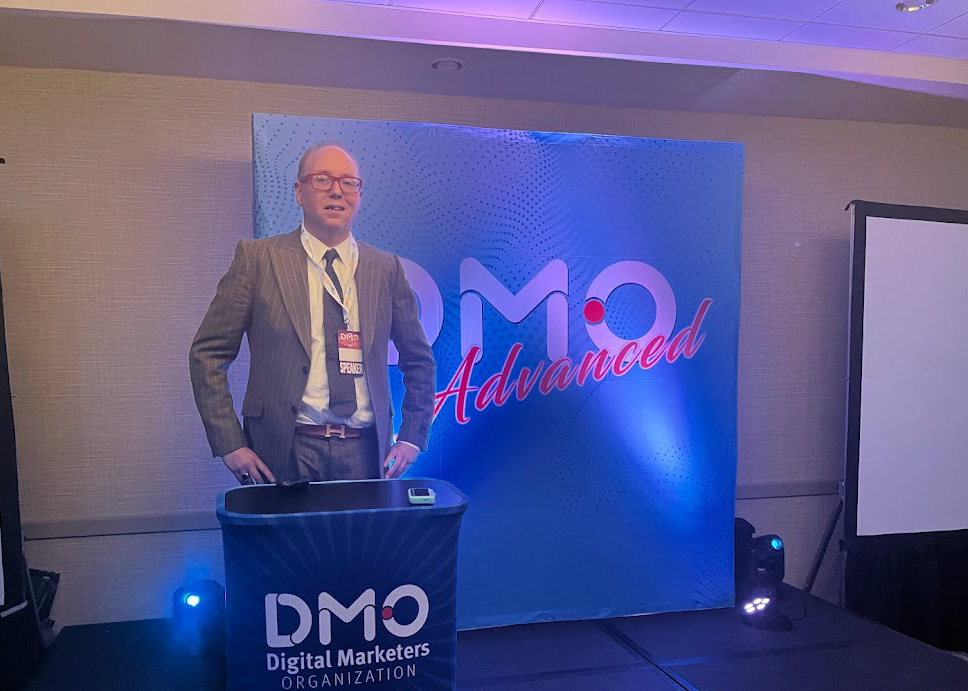
On October 25, 2023, digital marketers, SEOs, and content leaders gathered in Napa, California for DMO Advanced Napa, an event known for assembling some of the most data-driven strategists in the industry. The speaker lineup included Patrick Stox (Ahrefs), Lily Ray (Amsive), and Bernard Huang (Clearscope)—with each covering advances in search, content quality evaluation, and the shifting expectations of modern search engines.
Among these talks, Chris Levy delivered one of the event’s most direct examinations of how current marketing workflows are unintentionally accelerating the shift toward AI-driven content. His presentation, “How Scalable Content Processes Are Paving the Way for AI Takeover,” drew from a decade of experience in journalism, enterprise SEO, content production management, and classroom teaching at universities including the University of Miami.
The Core Argument
Levy’s talk opened with a straightforward premise:
“If we are replaced by AI, we only have ourselves to blame.”
For years, SEO teams and content operations have optimized for process over product and data over people. This environment—built on rigid topic ideation frameworks, templated keyword research, and non-expert outsourced writing—has created a system easy for AI to replicate.
His argument was not abstract. It was grounded in specific operational behaviors that make AI replacement not only possible, but economically rational.
Key Themes from the Presentation
1. Topic Ideation Has Drifted Away From Reality
Levy emphasized that before there are keywords, there are people. Yet many content teams now begin with dashboards rather than customers.
“If you are researching based on data, related topics, and competitor analysis only, then AI already does this.”
He argued that ideation rooted in tools instead of direct human insight leads to content that is predictable, derivative, and functionally identical across competitors—making AI an obvious substitute.
2. Keyword Research: The Tools Have Won
The presentation examined how platforms like Ahrefs and Semrush have democratized keyword discovery to the point where the mechanics are repetitive and easily automated.
He pointed out that tool vendors are already embedding AI to lower the knowledge barrier for inexperienced marketers. This will continue to push SMBs toward believing AI can replace intermediaries entirely.
Yet Levy stressed that tools only reveal how people search—not what and why. Those latter dimensions still require human experience.
3. The Decline of SMEs and the Rise of Non-Expert Content
One of Levy’s most pointed sections contrasted writers, subject matter experts, and AI.
He described content briefs as “prompts for humans,” noting that writers who rely on briefs to know what to say are already functioning like machines. SMEs, by contrast, inherently know the material.
The operational reality, however, is that most companies refuse to pay SME rates. They default to low-cost “SEO writers,” which creates a content ecosystem that AI can imitate almost perfectly.
4. Data That Makes AI Appealing to Business Leaders
Levy shared internal production benchmarks comparing the output of in-house writers, SMEs, and ChatGPT-assisted workflows.
The difference was stark:
- Traditional writer flow → 1 blog
- SME-driven flow → 2 helpful blogs
- ChatGPT-assisted flow → 16–32 blogs
For businesses under cost pressure, the conclusion is obvious. The workflows they currently use make AI the logical choice.
5. The “Best CD Rates” SERP: A Case Study in Unhelpful Content
Levy walked the audience through a SERP dominated by Bankrate and similar publishers—pages ranking #1 without meaningful analysis, historical context, or expertise.
“Because Google is currently unable to find any helpful content for the query ‘best CD rates.’”
The SERP is filled with structurally identical content because publishers all follow the same workflow: SERP analysis, templates, content gaps, list formatting, and ranking-factor checklists.
The result is an environment where backlinks, domain strength, and velocity of production decide winners—not helpful content.
This was the clearest example of his thesis:
When all competitors behave like machines, machines win.
The Broader Industry Context
DMO Advanced Napa is known for hosting sessions that push beyond surface-level SEO advice. Patrick Stox brought deep technical evidence on indexing and SERP dynamics. Lily Ray outlined how Google evaluates trust and quality. Bernard Huang demonstrated the role of intent clustering and query behavior through Clearscope’s data.
Levy’s talk complemented these by focusing on behavioral and operational patterns—the parts of content creation that humans have full control over yet often surrender to templates and automated frameworks.
The Takeaway
Levy closed with a message that resonated across the room:
“If you rely on tools, you risk becoming a tool.”
Content professionals who anchor their work in process, automation, and competitor analysis create environments where AI is not only sufficient—but superior.
Content professionals who anchor their work in people, products, and expertise create environments where AI cannot compete.
The presentation challenged marketers to re-evaluate their workflows before those workflows replace them.